Fall Conference Takeaways
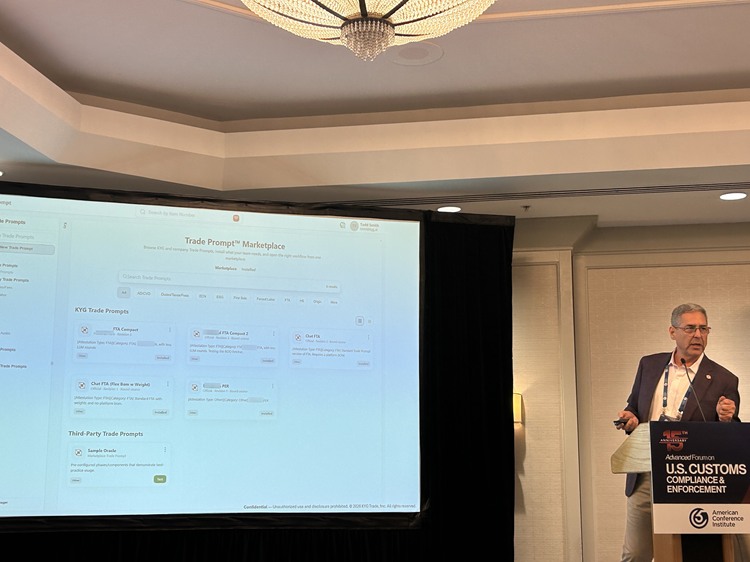
At KYG Trade, our fall conference observations point to a shared priority: preparing for tighter enforcement, higher documentation expectations, and closer scrutiny of product- and supplier-level data. When tariff and traceability pressure rises, gaps in records can become costly questions at the border.
But the answer isn’t simply to monitor changing requirements. It’s to strengthen the processes and incorporate automation that enable teams to respond. Across the conference cycle, we identified practical lessons for making compliance decisions more consistent, defensible, and easier to support – but not without increased headcount or automation.
Reading the Fall Conference Circuit as a Warning Sign
We had a full fall slate this season. We engaged with events hosted by:
- Customs and Border Protection (CBP) – The 2026 Trade and Cargo Security Summit (TCSS).
- The Technology Trade Regulation Alliance (TTRA).
- The Society for International Affairs (SIA).
- The Footwear Distributors and Retailers of America (FDRA).
- The United States Fashion Industry Association (USFIA).
- The Western Cargo Conference (WESCCON).
- The International Compliance Professionals Association (ICPA – US & MX).
- The Automotive Industry Action Group (AIAG).
Taken together, these events offered a practical read on where compliance pressure is heading across industries. Recurring concerns included supply chain scrutiny (UFLPA), tariff uncertainty (Executive Orders), enforcement pressure (import and export), and the work required to defend decisions with consistent records.
For us, the broader lesson is that trade compliance requires new tools to manage increased regulatory scrutiny of documents, document chains, suppliers, customers and brokers. Treating documentation as something to assemble after a transaction, leaves your team reconstructing decisions when it should be providing evidence. It’s more effective to examine classification, origin, traceability and documentation controls before adding more monitoring tasks to an already stretched team.
Prioritizing Classification, Origin and Documentation Discipline
We came away with a clear priority: keep product and supplier facts connected to the decisions they support. This is easier said than done due to legacy processes that prioritize transaction speed over compliance.
Classification — the assignment of a product’s customs tariff code — depends on its attributes. Your records should explain which attributes informed the decision, how they were analyzed, which regulations were brought to bear and not just preserve the final code. This needs to be done at scale, integrated with your ERP and with daily regulatory updates.
The same principle applies to origin and customs valuation. A conclusion without its supporting logic leaves the next reviewer with unanswered questions. Can your team quickly retrieve a concise report that cites the relevant product information and explains how it reached the declared origin or value?
Technical expertise and documentation discipline need to work together. Even a carefully reviewed decision becomes harder to defend when your broker’s records differ from supplier files or internal systems.
The hidden challenge is not whether it can be done manually with current processes. It can. It’s where the time or human resources come from to do it, without enterprise-ready automation. Throughout your reviews ask, “how can this be done faster and more accurately?” The answer is likely going to be either with more people or with AI-assisted automation.
Here’s a review framework you can use to connect each risk area with an operational check:
| Risk area | What teams should verify now | Common weak point | Operational impact |
| Classification | Product attributes and documented classification rationale | A code retained after product details change | Incorrect duty treatment and rework |
| Origin | Evidence supporting origin and any preference claims | Supplier support disconnected from the product | Questioned claims and review delays |
| Valuation | Declared value and supporting calculation records | An amount without an explanation | Reconciliation work and audit exposure |
| Documentation / traceability | Consistent, linked records and a retrievable decision history | Conflicting documents across teams | Slower responses and clearance delays |
Keeping records aligned requires more than individual diligence. It requires a shared operating process and a way to execute accurately and consistently without adding headcount.
Building Non-Negotiable Systems and Traceability
True traceability means being able to follow a product-level decision back to its evidence, reviewer, and subsequent changes. That connection should survive a handoff between teams. This is what CBP, BIS, the State Department and other regulators expect.
If your staff must search email chains, compare spreadsheets, and request the same supplier files repeatedly, adding another checklist won’t resolve the underlying fragmentation. You need a controlled and automated way to maintain records and coordinate decisions.
We recommend starting with the workflow. Establish where approved information lives, what documents or information are missing, who owns each document, and what triggers a review. Then assess whether your existing systems can support those controls across import, export, free trade agreement (FTA), forced labor and environmental, social, and governance (ESG) compliance work.
A system-driven approach should make shared information easier to maintain without giving every participant unrestricted access. Keep permissions aligned with responsibilities and preserve the history behind changes.
The test is practical: can your team answer a product-level question without rebuilding the file? For example, where was the natural rubber in a gasket grown? Do you have documentary evidence to prove it?
Creating a Practical Preparation Plan for Trade Compliance Teams
We recommend a focused review or exercise you can assign now, rather than a never-ending, open-ended data cleanup. Start with high-risk products/geographies and the handoffs connecting sourcing, compliance, brokers, logistics, and ESG stakeholders. Mock detention exercises, for example, are becoming more relevant for this purpose.
Give each task an owner and a completion date. For lean teams, a bounded review is easier to execute and exposes where broader improvements are needed.
Use these five steps to turn our conference takeaways into action:
- Review high-risk SKUs. Confirm that product details and classification rationales are complete, current, and retrievable.
- Check origin and FTA support. Match supporting evidence to the products and claims it’s intended to substantiate.
- Test documentation consistency. Compare supplier files with internal records. Resolve conflicting versions and identify the approved record.
- Align broker and internal data. Check that declared information reflects approved decisions and establish how corrections reach every relevant party.
- Run an audit-readiness drill. Request a complete product file, time the response, and check document ownership, escalation paths, and decision history.
We’d treat unresolved gaps as assigned corrective work, not simply findings to archive. The value lies in fixing weak processes before a live request tests them.
Turning Conference Lessons Into a Stronger Compliance Posture
Our strongest takeaway is that readiness depends on more than knowing what changed. Your team needs a reliable connection between product facts, compliance decisions, and supporting evidence. Tighten that connection now, and you’ll have a firmer basis for responding when requirements shift.
Contact us to discuss how your team can strengthen product-data controls and prepare for changing compliance requirements.


